
• Sony Is Ending PlayStation Game Discs in 2028: Why Gamers Are Fighting Back

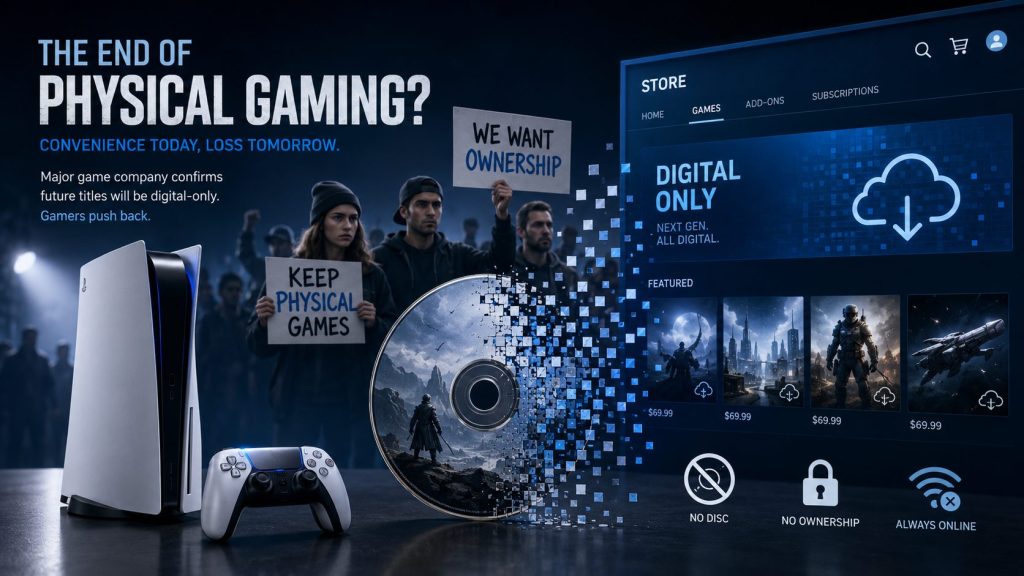
    Illustration accompanying the debate over Sony ending physical PlayStation game discs in 2028

    Sony’s decision to end production of physical PlayStation game discs for new releases starting in January 2028 has sparked a major backlash among gamers, collectors, retailers, and consumer-rights advocates.

    While Sony points to changing buying habits and the growing popularity of digital downloads, many PlayStation owners see the decision as something much bigger than a format change.

    For these players, the debate is about ownership, consumer choice, resale rights, game preservation, and whether purchasing a digital game truly means owning it.

    On July 1, 2026, Sony Interactive Entertainment officially announced that new PlayStation games released beginning in January 2028 would be available only in digital formats, including through the PlayStation Store and retailers.

    Importantly, Sony stated that the change would not affect games already released on disc or those scheduled for disc release before January 2028.

    But that distinction has done little to quiet the controversy. Many players believe digital convenience should remain an option rather than become their only choice.

    Is Sony Really Ending Physical PlayStation Games in 2028?

    Yes. Sony has confirmed that physical disc production for new PlayStation games will end starting in January 2028.

    According to Sony’s official PlayStation announcement, the transition will apply to new games released after the cutoff.

    Here is what the announcement means for players:

    • New PlayStation games: New releases beginning in January 2028 will be distributed digitally rather than on playable game discs.
    • Existing physical games: Games released on disc before the cutoff are not affected by the announced production change.
    • Retail purchases: Retailers may continue selling new games in digital formats, but a physical box containing a download code is not the same as a playable disc.
    • Used games and collecting: The transition will eventually reduce the availability of new physical releases for trading, lending, and resale.

    Sony acknowledged strong reactions to the announcement during its July 31, 2026 earnings discussion. However, company leadership indicated that the transition would move forward cautiously.

    Digital Game Sales Are Growing, but Physical Games Still Matter

    Sony has a legitimate business argument for moving toward digital distribution: most PlayStation games are already purchased digitally.

    According to Sony’s financial reporting, digital downloads accounted for 78% of PlayStation 4 and PlayStation 5 full-game software unit sales during fiscal year 2025.

    That is a significant majority, but it also means approximately 22% of full-game units were not digital downloads.

    Across hundreds of millions of annual game sales, that represents a substantial physical market.

    These figures also need to be interpreted carefully. Sony’s full-game download ratio measures units sold digitally compared with total full-game units. It is not a measure of the percentage of gamers who prefer digital purchases, nor does it account for every type of gaming transaction.

    Sony’s published PlayStation sales data demonstrates the enormous scale of the gaming market.

    Digital sales may show where the market is heading, but they do not prove that physical media has lost its value or that players want physical games eliminated.

    Physical Games vs. Digital Games: What Do You Actually Own?

    One of the biggest concerns surrounding Sony’s decision is the difference between owning a physical game and purchasing digital access.

    When someone buys a physical game disc, they generally possess a copy they can keep, lend, trade, resell, or collect. Physical ownership does not eliminate copyright restrictions, and some modern games still depend on downloads, online authentication, or servers.

    Nevertheless, a playable physical copy can provide more independence from a digital storefront.

    Digital purchases operate differently. Players generally receive a license to access software under the platform’s terms and applicable laws. That access can depend on account status, licensing arrangements, platform support, and other restrictions.

    For consumers, the distinction raises an important question:

    If you pay full price for a digital game, should the company selling it be able to limit or remove your access later?

    That concern is not unique to PlayStation, but Sony’s recent history with purchased digital video content has brought it into sharper focus.

    Sony’s Digital Content Controversies Raise Ownership Questions

    In December 2023, PlayStation notified customers that previously purchased Discovery television content would be removed from their video libraries because of licensing arrangements.

    Sony subsequently reversed that planned removal after reaching updated licensing arrangements. The content remained available, but the original warning demonstrated how digital purchases can depend on agreements beyond the customer’s control.

    Then, in June 2026, Sony notified PlayStation customers in the United Kingdom that access to 551 previously purchased StudioCanal movies and television titles would end on September 1, 2026.

    Reports identified affected films including Terminator 2: Judgment Day and Apocalypse Now. The announcement cited licensing agreements, and reports indicated that Sony did not offer affected customers refunds.

    These examples concern digital video purchases rather than PlayStation games, so they should not be interpreted as proof that Sony plans to remove purchased games.

    However, they illustrate why consumers are concerned about relying entirely on digital libraries.

    For players considering an all-digital PlayStation future, the central concern is straightforward: what happens to purchased content when licensing agreements, platform policies, or online services change?

    Why Gamers Are Fighting Sony’s Decision

    The backlash against Sony’s announcement has extended beyond social media complaints.

    Canadian game retailer PNP Games launched the Don’t Kill the Disc petition on July 1, 2026, urging Sony to preserve physical PlayStation releases.

    The petition has attracted hundreds of thousands of verified signatures, reflecting significant opposition to the transition.

    Its central argument is not that digital games should disappear. Rather, supporters want physical and digital formats to coexist.

    That distinction matters.

    Digital games offer meaningful advantages. Players can download titles without visiting a store, switch games without changing discs, and maintain large libraries through a single account.

    However, physical games provide benefits that digital storefronts cannot fully replicate:

    • Trading or reselling games after finishing them.
    • Lending games to friends and family.
    • Buying discounted used copies from independent retailers.
    • Collecting physical editions and preserving gaming history.
    • Playing compatible offline games without depending entirely on future downloads.

    Some frustrated players have adopted a “no disc, no buy” position, threatening to stop purchasing future PlayStation products if physical releases disappear.

    Whether that reaction ultimately changes Sony’s plans remains uncertain.

    Will Digital-Only PlayStation Games Cost More?

    Another major concern involves pricing and competition.

    Physical games create a marketplace where multiple retailers can compete on price. Stores can discount inventory, offer trade-in incentives, and resell previously owned copies.

    Players can also sell games they no longer want and use that money toward their next purchase.

    Digital-only distribution changes those dynamics.

    Although Sony says retailers will continue offering games in digital formats, consumers would lose the traditional used-disc marketplace for newly released PlayStation titles.

    Publishers and approved digital storefronts would consequently have greater influence over how games are priced and distributed.

    That does not necessarily mean digital games will always cost more. Digital storefronts frequently offer discounts, seasonal promotions, and subscription-based access.

    But those promotions are not equivalent to an independent resale market where consumers can determine the value of used copies.

    The issue is not simply whether digital games can be inexpensive. It is whether eliminating physical games reduces the number of ways consumers can find a better deal.

    What Happens to Game Preservation Without Physical Discs?

    Game preservation is another important part of the debate.

    Video games represent decades of creative work, cultural history, technical innovation, and entertainment. Preserving access to older games matters to players, collectors, researchers, and historians.

    Digital distribution can make games widely accessible while storefronts and supporting services remain available. However, those same games can become difficult to obtain when they are delisted or when services close.

    Physical discs are not a perfect preservation solution. Some modern releases require large downloads, patches, online verification, or persistent server connections.

    Still, a complete playable disc may remain usable long after a digital storefront stops selling the game.

    Collectors also value physical editions for their artwork, packaging, manuals, and historical significance.

    Moving entirely away from physical games removes one more method of preserving gaming history independently of online distribution platforms.

    Why PlayStation’s Digital Future Is Also a Question of Trust

    Sony’s greatest challenge may not be convincing players that digital gaming is convenient. Millions of consumers already understand its benefits.

    The bigger challenge is convincing players that their purchases will remain accessible and that they will retain meaningful control over what they buy.

    Consumers are accustomed to purchasing games, movies, books, and music with the expectation that those products will remain available to them.

    Digital licensing arrangements can complicate that expectation.

    For PlayStation customers who have spent years building game libraries, the end of physical discs raises questions about what those collections will mean decades from now.

    Will purchased games remain downloadable? What happens if a storefront closes? Will players still be able to access games that require online services?

    These questions do not have one universal answer because access depends on the game, license, hardware, and services involved.

    But they deserve attention before physical alternatives disappear.

    Can Sony Reverse Its Decision to End PlayStation Discs?

    Sony has announced its plans for January 2028 and reaffirmed that direction despite public criticism.

    That does not make a change impossible. Companies can reconsider product and distribution strategies when consumer demand, competitive pressure, or market conditions warrant it.

    However, there is currently no confirmed reversal of Sony’s announced disc-production cutoff.

    For players who want physical games to remain available, petitions, purchasing decisions, and direct feedback are ways to communicate that preference.

    The long-term outcome will depend on whether Sony believes maintaining physical distribution provides enough value to justify the associated costs.

    Final Thoughts: Digital Convenience Should Not Eliminate Consumer Choice

    Sony’s plan to discontinue physical PlayStation game discs for new releases may make sense from a business perspective.

    Digital distribution can reduce manufacturing and distribution costs, simplify logistics, and provide companies with greater control over their marketplaces.

    But what benefits a platform financially does not always provide the greatest benefit to consumers.

    For many gamers, physical media represents something that digital storefronts cannot fully replace: control over a purchased copy.

    A disc can be collected, resold, borrowed, or passed down. A physical game can also represent a personal memory, a collector’s item, or a piece of gaming history.

    The backlash against Sony is not simply nostalgia or resistance to technological change. It reflects concerns about ownership, affordability, preservation, and the future of consumer choice.

    Digital gaming is clearly here to stay. The question is whether that future really requires physical games to disappear.

    For hundreds of thousands of players supporting the campaign to preserve PlayStation discs, the answer is no.

    What do you think? Would you continue buying PlayStation games if digital downloads became your only option, or is physical ownership important enough to influence your next console purchase? Share your thoughts in the comments.

    Posted in video game | Tagged , , | Leave a comment

    The Persistent Problem of Pokémon Card Scalping in 2026

    Pokémon Card Scalping

    For decades, Pokémon cards have brought joy to kids, nostalgic adults, and competitive players alike. But in recent years, the hobby has been overshadowed by a frustrating and harmful trend: scalping. This practice—where individuals or groups buy up large quantities of products at retail prices only to resell them at inflated markups—has turned a beloved pastime into a battleground. Scalping doesn’t just inconvenience fans; it creates artificial scarcity, drives up costs, and erodes the sense of community that makes collecting so special.

    Pokemon Card Scalping and How to Stop It

    As we step into 2026, scalping remains a hot-button issue, though there are glimmers of hope. In this post, we’ll explore the current state of Pokémon card scalping and, more importantly, how you can avoid contributing to the problem.

    What is Pokemon Card Scalping, and Why Does It Matter?

    Scalping thrives on exploiting limited supply to create artificial demand. Scalpers use bots, fake accounts, and even coordinated groups to snatch up products from stores or online drops, flipping them on secondary markets like eBay or Facebook Marketplace for double—or even triple—the price.
    The problem reached a boiling point in 2025, with widespread shortages leading to empty shelves, frustrated fans, and even physical altercations in stores. The fallout? Kids missed out on birthday gifts, collectors struggled to complete sets, and the hobby began to feel gatekept by profit-driven opportunists.

    But scalping isn’t just about cards—it’s about the community. It erodes trust and fosters resentment. Take, for example, the recent bust in Tokyo, where police arrested a Vietnamese national who used over 500 fake accounts and illegal SIM cards to bypass purchase limits on Pokémon Center Online. The individual hoarded 30 booster boxes and profited over ¥4.2 million (about $28,000 USD). Similar stories have surfaced worldwide, from the Philippines—where scalpers cleared out toys bundled with free TCG packs—to the U.S., where retailers like GameStop have faced backlash for pre-selling items at scalper-level prices.

    The Current State of Scalping in 2026

    If 2025 was a nightmare for collectors, 2026 offers a mixed bag of progress. The Pokémon Company has announced plans to “saturate the market” by increasing production, aiming to make cards more accessible and undercut scalpers’ profits. Early signs suggest this strategy is working: sealed product prices are dropping, and some scalpers are exiting the scene as profit margins shrink.

    However, scalping hasn’t disappeared. Reports still surface of elderly couples flipping stock at card shows or stores facing backlash for mishandling inventory. Market analysts describe the situation as a “correction” rather than a full crash—while some cards have dipped 20% or more in value, high-demand items still command premiums. Forums and videos question whether increased supply is too little, too late, as the damage to fan trust lingers. Despite enforcement efforts and policy changes, scalping continues to cast a shadow over the hobby.

    The Real Impacts on the Pokemon Community

    Scalping’s effects ripple far beyond frustration. Here’s how it harms the community:

    • Accessibility for New Fans: Kids and beginners face barriers when sets sell out instantly, discouraging growth in the TCG community. The focus should be on art, gameplay, and Pokémon lore—not resale value.
    • Economic Strain: Inflated prices make collecting unaffordable, pushing fans toward counterfeit cards or giving up entirely. In extreme cases, it even leads to fraud, like the SIM card schemes in Japan.
    • Community Division: Trading, once a magical and social experience, now feels tainted by greed. As one collector lamented, “It’s sad when cards are valued solely for money, not the Pokémon themselves.”
    • Broader Effects: Retailers face backlash, and the hobby risks losing its wholesome, inclusive vibe. Even other TCGs, like One Piece, are seeing spillover scalping.

    How You Can Help Stop Scalping

    The good news? Individual actions can make a difference. Whether you’re a collector, trader, or casual fan, here’s how you can contribute positively without feeding the scalpers:

    Buy Responsibility and at MSRP

    Stick to official retailers like Pokémon Center, local game stores (LGS), or trusted websites. Avoid secondary markets unless prices are fair. Pre-order from legitimate sources, and report suspicious overpricing (e.g., GameStop’s $100 preorders for $50 items). Support The Pokémon Company’s increased supply by waiting for restocks instead of panic-buying.

    Don’t Flip for Profit

    If you snag extras, trade or gift them to friends or community members at cost. Collect for enjoyment, not investment. As markets cool, flipping becomes less viable anyway—focus on building your personal collection.

    Support Local and Ethical Sellers

    Shop at LGS events or Pokémon League meets. These venues often limit purchases per person, curbing scalpers. Plus, they foster community—play games, make trades, and keep the hobby social.

    Report and Raise Awareness

    Spot a scalper bot or bulk buyer? Alert store staff or share intel on platforms like Reddit’s r/PokemonTCG. On social media, call out bad practices (without doxxing). Join discussions to push for better policies.

    Diversify Your Hobby

    Explore digital options like Pokémon TCG Live for gameplay without physical scarcity. Or collect alternatives like fan art or merch that aren’t as heavily scalped. Remember, the true value lies in the fun, not the resale.

    By making these choices, you’re helping reclaim the hobby for genuine fans. Scalpers thrive on demand—if we starve them of buyers, they’ll move on.

    A Brighter Future for Pokemon Collectors?

    Scalping in 2026 is showing signs of easing, thanks to production boosts and enforcement efforts. But real change starts with us—the community. By prioritizing joy over profit and fostering inclusivity, we can rebuild trust and make the hobby magical again.

    What’s your experience with scalping? How are you fighting back? Share your thoughts in the comments below—let’s keep the conversation going and the community thriving.

    Posted in Card Games | Tagged , , | Leave a comment

    3rd Party DnD Campaigns You Should Try!

    3rd Party DnD Campaigns

    Have you gone through all the Wizard of the Coast’s DnD settings? You should try some 3rd Party DnD Campaigns at your table!

    Dungeon & Dragons is an amazing game that allows players to explore different worlds and stories. However, what happens when you use all the DnD settings that Wizard of the Coast made? A lot of tables homebrew their own stories and worlds but setting up those stories can be long. Fortunately, there are plenty of creative people who have written and published their campaign settings! Here are some campaign settings you can use to explore different worlds outside of the Forgotten Realms.

    Fool’s Gold: Into the Bellowing Wilds

    The Writer Owns this Module

    This is the perfect campaign for Dungeon Masters and players who want to wild and chaotic Indian Jonas adventure. Based on a Youtube series by Dingo Doodles, the campaign takes you into the Bellowing Wilds, the world’s most dangerous jungle. Journey through the jungle as you uncover the mystery of the ancient Foreclaimer empire as players encounter powerful and dangerous foes like a duck in a wizard hat!

    This campaign setting provides a variety of new character creation options, including 4 new races and 10 new subclasses. Each party of the adventure is crazier and funnier than the last, so we highly recommend playing!

    Obojima: Tales from the Tall Grass

    The Writer Owns this Module 

    While the book has not been delivered yet, people who order the PDF can tell you that this campaign is different from the Forgotten Realms. Set on the island of Obojima, people will be a treated to world that is heavily inspired by Studio Ghibli and Breath of the Wild.

    The island of Obojima is a place where only the material and spirit realm exists; creating an environment that is distinct from the Forgotten Realms. The island is covered in 1980s technology that comes from the First Age, allowing a blend of retro technology and fantasy themes. The world offers unique character creation options as players explore the world and find out about the Corruption that is spreading throughout Obojima.

    Posted in Table Top Games | Tagged , | Leave a comment

    New Table Top Games You Should Play

    Have you been interested in trying out a new table top game for your weekly game night? People love Dungeons and Dragons but sometimes people wants a change of pace. While some creative DMs will use the DnD system to create different games, there are plenty of table tops games that ready to go and provide a unique role playing experience.

    Vampire: The Masquerade

    If you an avid video gamer, you might know about the video game adaption of this table top game Vampire the Masquerade Bloodlines. However, the table top version provide more exciting and unique opportunities. The settling allows players to create vampires that are hiding plain sight but thriving in the night. Players can choose from a variety of clans to create unique characters with talents and flaws as they navigate vampire society and the masquerade.

    Vampire: The Masquerade is part of the World of Darkness series which offers other table top games that features other creatures of the night and the hunter who exterminate them!

    Vampire the Masquerade has some unique dice so get some before you start playing! 


    Cyberpunk

    Are looking to play in a futuristic, dystopian society? Cyberpunk is the table top game for you. Although Cyberpunk 2077 had rocky start, the video games has made a major surge thanks to its patches and the release of the Phantom Liberty DLC. This video games has exposed people to the original source material; the Cyberpunk Table Top game. You and your party members can explore Night City with your own personal stories.

    Become a Night City Legend with this great tablet op game!

    Lancer

    Explore the stars as mech pilots in Lancer! Lancer is sci-fi setting that provides interesting story and excellent combat. Each player gets to create mech pilots, who explore space in their own custom suits. There is a such a variety of options to spec into making your mech fit your play style. There is plenty of unique storylines to play in the sci-fi setting.

    Posted in Table Top Games | Tagged , , | Leave a comment

    Best D&D Campaigns for Beginners

    Dungeons and Dragons campaigns for beginners
    When you have newcomers at your table, you want to find the best campaigns for beginners. A player’s first game will determine whether or not they continue to adventure the Forgotten Realms and other regions or never pick a die again. While many dungeon masters like to play with their world, a pre-written campaign can be the easier starting point for new players. The Dungeon Mast can focus on making sure the experience is amazing without having to worry about the finer points of world-building. Here are the best campaigns that you should run with new players.

    Curse of Strahd

    Curse of Strahd is a remake and expansion of the original Ravenloft module. Taking place in the dark land of Barovia, the players are pitted against one of the most iconic characters in Dungeon & Dragons, Strahd von Zarovich. While one of the hardest campaigns, it is easy for Dungeon Master to run. In addition, this will be the perfect campaign if your new players are fans of the supernatural and horror genre.

    Waterdeep: Dragon Heist

    While a lot of adventures end up with the players saving the world from a great evil, Waterdeep: Dragon Heist provides a low-stakes and grounded story. This adventure allows players to get more comfortable with battle mechanics as they explore the intrigue that Waterdeep has to offer. Players can get their feet wet in the Forgotten Realms’ lore while searching for a stockpile of gold!

    Candlelight Mysteries

    While some DMs want to do extended stories, sometimes short adventures can be just the ticket to get new players invested. The Candlelight Mysteries module provides a variety of small, disconnected adventures that will allow new players to ease into playing Dungeons & Dragons with an anthology.

    Posted in Table Top Games | Tagged , , | Leave a comment